

The Economic Trap Strangling Iran's Regime
The triple crisis of Iran's regime: economy, legitimacy, and state capacity

Welcome to our third Phase Reading, our monthly format where we explore a global trend in politics, technology, economy and society, or all of these together, when we want to follow the longer threads behind the news.
Today, we talk about the economic crisis engulfing Iran and the political consequences for the Islamic Republic. We explore why current economic distress is structural and poses an existential challenge to the regime, despite the brutal crackdown of the protests in January, and why the regime will have a hard time fixing it without implementing serious changes, for which it has no clear path. Finally, we link the situation to current talks with the United States and the Iranian attempt to get sanction relief. Little did we know that talks would take place a few days before publication! Hopefully, this helps explain what is going on.
We will talk about:
Why this matters
The January protests in Iran signal deep discontent with the regime that goes beyond immediate circumstances and has assumed a structural character. The economic roots of this dissent, which we outline here, are rooted in the regime’s own institutional architecture, and they narrow its room for manoeuvre to rebuild legitimacy and maintain its grip on power. The dynamic we describe here also tells a deeper story about the trade-offs between political and economic priorities, especially in systems characterised by opaque accountability. Direct elite control over the economy can generate contradictions that are impossible to resolve without drastic measures or, at times, without a revolution.
In Iran, inflation has been terrible for several years. It was especially brutal in 2025. By the end of December, the currency was depreciating so quickly that mobile phone shop owners were not able to set prices for the day:
We have one price in the morning and another in the afternoon. When a customer comes, we ask them to wait until we get the day’s price, but of course the customer won’t accept and gives up on buying. (Source. In Farsi, read in English translation courtesy of ChatGPT.)
On 28 December 2025, they had enough, closed the stores and took to the streets in a spontaneous demonstration, soon joined by tens of thousands of protesters. In just a few days, the protest turned into possibly the largest uprising ever faced by the Islamic Republic. Riots and clashes across hundreds of localities called for the demise of the regime and targeted facilities of the regime’s security forces.
Perceiving the threat as existential, the regime responded with brutality, violently suppressing the protests. Official figures acknowledge more than 3,000 deaths, while overseas-based NGOs estimate the toll at between 6,000 and 30,000, alongside tens of thousands of arrests, including assaults on medical facilities that provided treatment to injured protesters.
And yet, even after the crackdown succeeded in quelling the unrest, most observers agree that the regime has close to no chance of surviving in its current form. Acts of defiance are still being reported, suggesting that the determination of the Iranian people to topple the regime has not been stifled, but it is the abysmal economic situation that threatens the regime’s grip on power. Yet despite this broad consensus, we did not find any clear explanations of why the system is so fragile.
What is it, then, that makes the situation so difficult to manage for the regime, to the point of being possibly fatal? Why do the State and all the entities affiliated with the Islamic Revolutionary Guard Corps (IRGC) not have the ability to recover the situation? We took a deep dive to understand it.
Iran’s economic problems are essentially two: an inflationary crisis and structural weakness in the financial sector. Both factors have root causes in the very structure of the regime and are strictly intertwined, making them hard to solve without long-term political consequences, as we will see.
The roots of hyperinflation
Prolonged hyperinflation has been Iran’s major source of economic pain for years, staying above 30% in the last 5-6 years and peaking over 50% in 2025 – 70% for food items. At the beginning of the war with Israel in June 2025, the exchange rate stood at 880,000 rials to the dollar. By December, it had risen to 1,440,000 rials per dollar, making imports increasingly harder and eroding living standards.
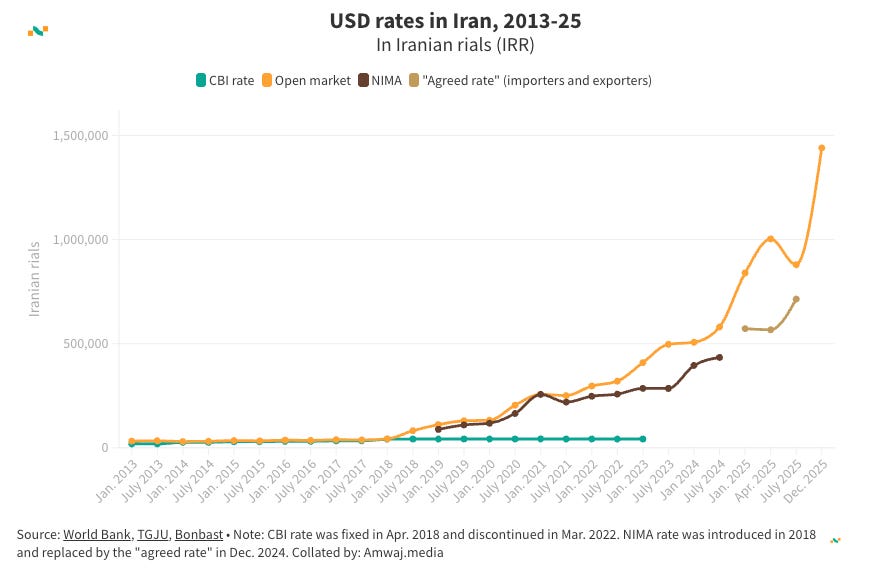
The main drivers of the extreme level of inflation are: i) the need for the State to finance persistent budget deficits, ii) international – especially US – sanctions, and iii) monetary policy.
For the last several years, the Iranian government has faced spending needs it has not been able to cover through revenues. On the one hand, this is due to spending rigidities related to current expenditures, which are politically costly to reduce, such as wages, pensions and subsidies, as well as financing the security forces. On the other hand, the State has been unable to raise significant tax revenues. It is estimated that Iran’s tax revenues hover around 9% of the GDP, while expenditure is around 12-13%. As a reference, in advanced economies, tax revenues are consistently above 30% of the GDP.
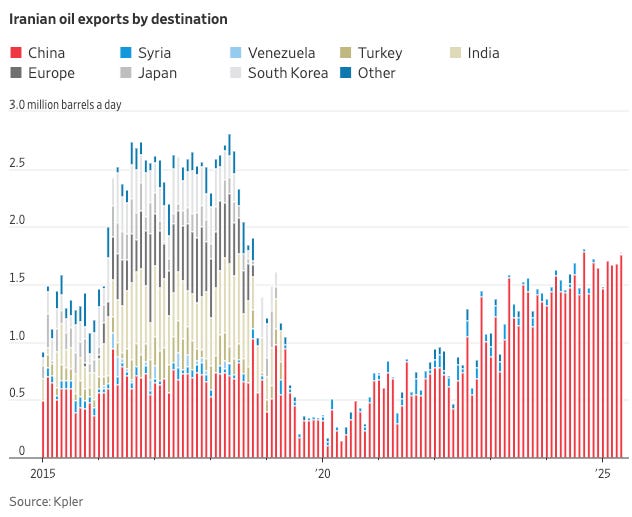
This is where sanctions first come in, as they strongly limit Iran’s ability to use oil revenue and finance its budget. In practice, since the US imposed sanctions in 2018, Iran has been able to sell oil only to China, often at a steep discount.
This forces the government to run chronic fiscal deficits, which it can finance through three channels: i) debt issuance, ii) borrowing directly through the banking system, and iii) drawing on the country’s sovereign fund. Sanctions constrain transactions in and out of Iran and limit foreign borrowing, and the domestic market does not have the capacity to lend what the government needs to regularly function. This pressures the government to borrow directly from the banking system.
As we will see, the Iranian banking system is heavily intertwined with the State apparatus, with many banks either state-owned or linked to public or quasi-public trusts. This creates strong political incentives for banks to absorb government debt and expand their balance sheets. When this mechanism strains banks’ liquidity, the Central Bank of Iran (CBI) has to support that balance-sheet expansion through liquidity provision, increasing the money supply and fuelling inflation. We will see that this is precisely the case. Similarly, when the government supports the deficit by borrowing from the sovereign wealth fund, it transfers foreign assets to the Central Bank, once again increasing the money supply and inflation.
This is compounded by the CBI monetary policy, which keeps the interest rates low relative to inflation to favour debt servicing. Interest rates have been between 21 and 24% for the last 5 years, against an inflation between 30% and 50%, meaning that real interest rates have been consistently negative, roughly between -10% and -25%.
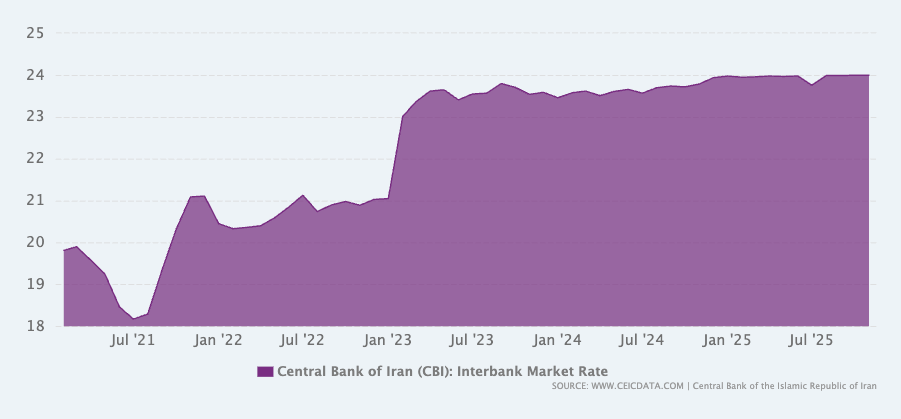
This monetary policy makes it very easy to borrow money, and it helps stabilise public debt, as the real value of debt contracted in the past continues to shrink.
On the other hand, though, this is punishing for lenders and pushes them out of domestic financial assets towards foreign assets. However, because this is extremely complicated and costly under US sanctions, it forces financial institutions to invest in other assets or weaken their balance sheet. Which leads us to the second problem afflicting the Iranian economy.
Banking sector woes
In October 2025, the Central Bank of Iran (CBI) revoked the license and dissolved Ayandeh Bank, one of the major private banks in the country. Ayandeh was founded in 2013 by Ali Ansari, a real estate tycoon with ventures also in steel, telecommunications, hotels, and sports, and the head of one of the richest families in Iran.
Ayandeh offered the highest interest rate on the market, attracting more than 7 million depositors. It then channelled this money into loans for the bank’s own subsidiaries and projects tied to the Ansari family itself, most notably the immense Iran Mall, the world’s largest shopping complex. Like many others, this project proved unprofitable in a country where one-third of the population lives below the poverty line, adding to Ayandeh’s debt burden.
According to CBI estimates, Ayandeh borrowers missed 97% of their payments, resulting in massive debt that the bank could not repay. Before its dissolution, the bank had 1,400tn rials ($1.3bn at the time) in non-performing loans, against only 2,500tn rials ($2.3bn) in deposits and 16tn rials ($14.8mn) in capital.
To stay afloat, the bank borrowed massively from the CBI, to which it owed 5,000tn rials ($4.7bn). In other words, the Central Bank allegedly printed money on a scale of billions, worsening inflation to support Ayandeh and the Ansari family’s financial activities. Although this may serve better as a qualitative picture, the Iranian Economic Activists Association estimated that CBI loans to Ayandeh alone increased the money supply by 25%, contributing to 5% of the current inflation and reducing the rial’s value by 30%.
What matters here is that Bank Ayandeh offers a window into a wider problem. When the CBI moved to dissolve the lender, it also signalled that stress extended to several other banks, including major state-owned institutions that are key to the stability of the Iranian regime.
The Iranian state and its financial institutions
While dissolving Ayandeh, the CBI mentioned 5 major banks in need of financial support. Among them was Bank Sepah. Sepah is Iran’s oldest bank and one of the largest state-owned banks.
Until 2020, Bank Sepah was directly connected with the Department of Defence, for which it managed financial operations and payment of agents abroad,1 reason why it is under US sanctions. In 2020, however, other 4 banks and a credit institution were merged into Sepah. Two of these were Ansar Bank and Mehr Eqtesad Bank, created in the late 2000s and directly controlled by the IRGC. These two banks were deeply involved in IRGC financial operations. IRGC members received salaries through Ansar Bank, while Mehr Bank paid dividends to the Foundation, financing the activities of the Basij, a paramilitary militia under the IRGC.
These and the other three banks – connected with the military and the police – were merged into Bank Sepah because they were all experiencing some sort of financial trouble. This worsened Sepah’s medium-term financial position, as manifested by its inclusion in the list of institutions in distress in late 2025.
However, there was also a political reason behind the merger: reducing the footprint of the military in the financial sector. In fact, the IRGC does not operate under the Ministry of Defence but answers directly to the Supreme Leader. Through the merger with Bank Sepah, the IRGC has acquired an indirect financial interest in the bank through the entities previously controlled by Ansar and Mehr Bank.
This highlights a key working mechanism of the Iranian economy and governance. Since the beginning of the Islamic Republic, large sectors of the economy have been de facto managed through charitable trusts – bonyad in Farsi. It is estimated that bonyads control up to 20% of the Iranian economy. Formally, these trusts cannot make any profits, which they are bound by law to redistribute to “the oppressed”2. In practice, they have an opaque structure and, being under the direct control of the Supreme Leader, they do not respond to the government despite being public institutions.
Like the IRGC itself, this creates a parastatal structure that acts independently of the government, where economic activities are managed by parallel institutions, similar to totalitarian regimes, where the State is managed in parallel by the government and the single party.
The bonyads serve to advance the interests of the IRGC and other state or parastatal bodies, creating a dense web of overlapping interests and jurisdictions. The result is an overextended and hypertrophic bureaucracy that effectively subsidises large segments of the economy while promoting the political interests of specific groups, or even particular individuals within those groups, inside the regime. It was precisely through one such foundation, Bonyad Taavon Sepah, that the IRGC established Ansar Bank and Mehr Bank, later merged into Bank Sepah.
In this system, the management of financial institutions does not reflect Iran’s macroeconomic needs, but rather the immediate political interests of those who control them. Institutions are created, merged or dissolved to promote the financial and political priorities of different actors – the IRGC, the police, the ministries – and power struggles between them, even this pushes financial institutions towards insolvency.
In theory, tools to reduce hyperinflation exist. Increase interest rates, reduce easy access to credit, let distressed institutions go down. In practice, political constraints prevent the regime from undertaking that path. This would imply reduced control over the economy by regime actors – especially the IRGC – and, thus, reduced political control. The recession that would likely ensue makes the option even less appealing.
Overall, sanctions, the need to finance state and parastatal activities – including security forces – and the resulting budget deficit continue to narrow the room for manoeuvre of financial institutions, further weakening their balance sheets. Even if the central bank remains “committed to” guaranteeing deposits at troubled banks, this comes at the cost of constantly pumping new money into the economy, causing persistent hyperinflation and deteriorating economic conditions.
What happens if salaries no longer allow police officers to sustain an adequate standard of living? Will they continue to uphold the regime, or will they join the next uprising?
The regime at a crossroads
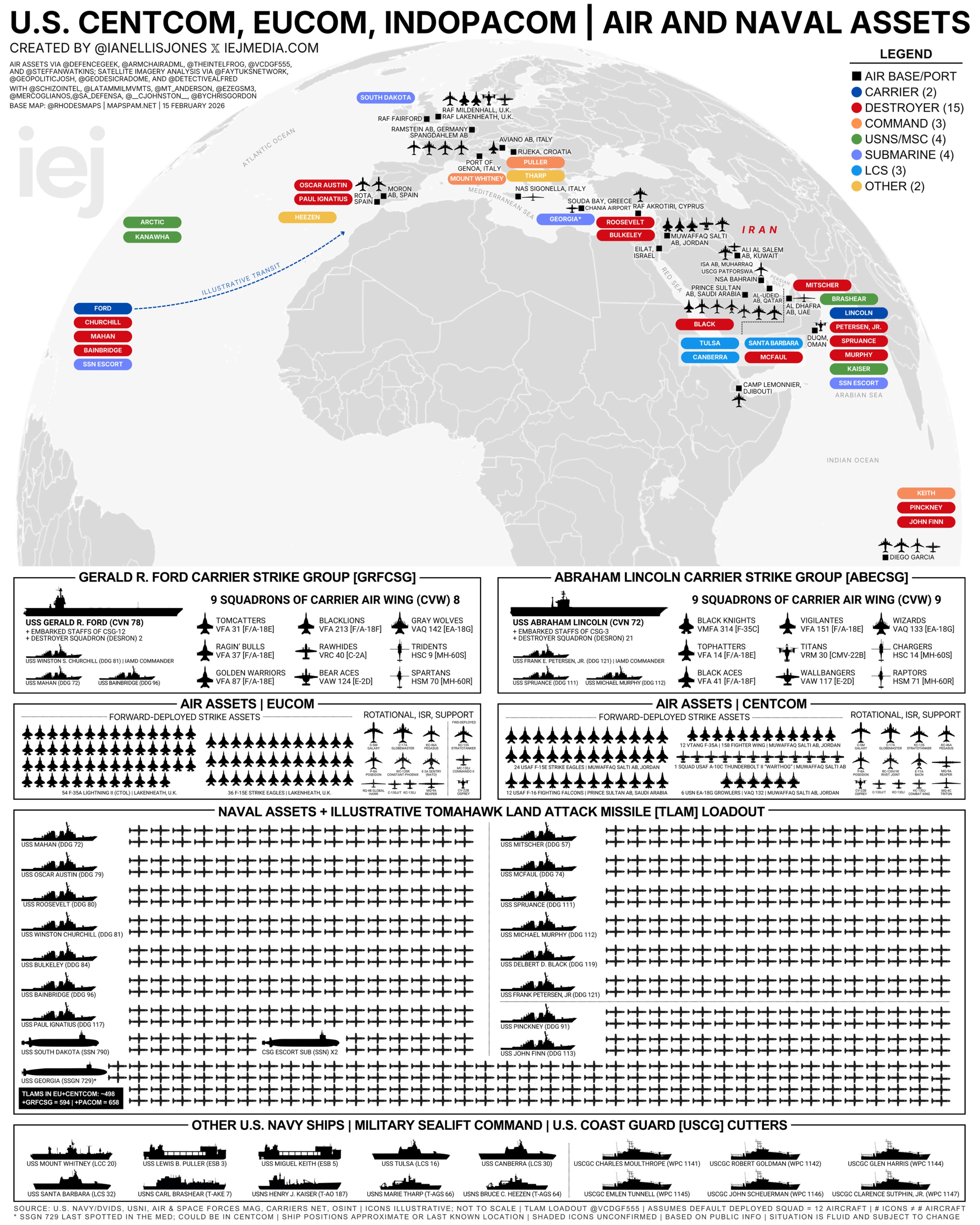
The uprising in January certified a regime crisis that might not have a solution. The timing is also far from great for the Islamic Republic. Ayatollah Khamenei is 87 years old, does not enjoy good health, and there are no clear rules for succession. Although it is impossible to make certain predictions, his passing is likely to deepen the legitimacy crisis of the regime, and maybe even spark an internal struggle to control succession.
In this context comes the regime’s recent engagement with the United States. The only route that would allow it to survive in anything resembling its current shape is some easing of sanctions, enough to increase oil revenues, reduce the budget deficit, and secure the foreign currency needed to support the rial, without fundamentally altering the existing political-economic system3.
It is far from clear that this will be possible. It is not clear, either, what kind of reforms the United States will demand, but they may be politically unacceptable for the regime, or they could deepen its crisis. Trump could try to push through reforms he prefers at gunpoint – whether or not they are in Washington’s interest – or he could just as suddenly decide to bomb.
Whatever Trump decides, the regime faces an existential crisis, and it will have to accept significant pain to stay in power, even at the cost of completely reshaping itself.
The main source we were able to find is the sanction press release by the US Treasury. It is definitely not an independent source, so, although we would expect a high-accuracy investigation, the political motivations behind it should recommend caution.
The Constitution of the Islamic Republic of Iran explicitly establishes that the State has to improve the living conditions of the mostazafin, usually translated as “the oppressed” or “the most vulnerable”. Interestingly, in a speech, Ayatollah Khamenei rejected this interpretation of the term mostazafin, which would instead refer to those who possess inner fortitude and who will inherit the Earth. Which, of course, gives a totally different political sense to bonyads’ redistribution practices.
This piece was written before the beginning of the US-Iran talks. Apparently (gift article), Iran offered to halt its nuclear programme for three years and send its enriched uranium abroad, in exchange for significant sanction relief, which speaks to the degree of desperation in Tehran. The US have signalled that the offer is not enough, though.